Will it affect my sex drive?
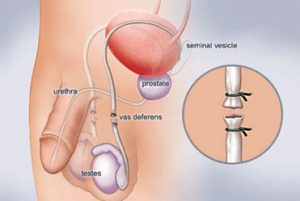
No. The sex hormones made by the testicles (testes) - for example, testosterone - continue to be passed into the bloodstream as before. Also, vasectomy does not reduce the amount of semen when you come (ejaculate) during sex. Sperm only contribute a tiny amount to semen. Semen is made in the seminal vesicles and prostate higher upstream.
Sex may even be more enjoyable, as the worry or inconvenience of other forms of contraception is removed.
What happens to the sperm?
Sperm are still made as before in the testicles (testes). The sperm cannot get past the blocked vas deferens and are absorbed by the body.
Is it reversible?
Do not consider having the operation unless you and your partner are sure you do not want children, or further children. Consider all sorts of situations, including a tragedy in the family or a break-up of your relationship. Only have a vasectomy if you are sure you would not want more children even in those situations.
It is wise not to make the decision at times of crisis or change, such as after a new baby or termination of pregnancy. It is best not to make the decision if there are any major problems in your relationship with your partner.
Remember there are reversible forms of long-term contraception which are very effective. Consider these as a couple before making your decision. These are all for women.
Ideally, both partners are happy with the decision before a vasectomy. However, it is not legally necessary to obtain your partner's permission.
Is vasectomy done in the Public Health System (for free)?
Yes – but unfortunately the wait time is very long (2-5 years).
Does the operation hurt?
No more than any other minor operation that uses local anaesthetic. The injection of local anaesthetic may sting a bit for a few seconds. It is put in just a small area of skin. After this, the operation is usually painless. After the operation, when the local anaesthetic wears off, the top part of the scrotum is normally mildly sore for a few days.
What if I change my mind?
Vasectomy is considered permanent. There is an operation to re-unite the two cut ends of the vas deferens. It is a difficult operation and not always successful. It is also not available on the NHS, so you would have to pay for this yourself.
How soon after the operation can I have sex?
It is recommended to abstain from sex for between 2 to 7 days after the vasectomy. However, remember you will have to use other methods of contraception until your semen specimen has been confirmed as clear of sperm. Some sperm will survive upstream from the cut vas deferens for a few weeks.
Can my partner tell if I have had a vasectomy?
Sperm adds very little to the semen volume, so you shouldn't notice any change in your ejaculate after vasectomy. Your partner may sometimes be able to feel the vasectomy site. This is particularly true if you have developed a granuloma.
Will my sense of orgasm be changed by having a vasectomy?
Ejaculation and orgasm are not affected by vasectomy. The special case is the rare man who has developed post-vasectomy pain syndrome.
Can I develop erectile dysfunction after a vasectomy?
A vasectomy does not cause erectile dysfunction.
Can something happen to my testicles?
In rare cases, the testicular artery may be hurt during vasectomy. Other problems, such as a mass of blood (hematoma) or infection, may also affect the testicles.
Can I have children after my vasectomy?
Yes, but if you haven't stored frozen sperm you'll need an additional procedure. The vas deferens can be surgically reconnected in a procedure called vasectomy reversal. If you don't want to have vasectomy reversal, sperm can be taken from the testicle or the epididymis and used for in vitro fertilization. These procedures are costly and may not be covered by your health plan. Also, they don't always work. If you think you may want to have children one day, you should look into non-permanent forms of birth control before deciding to have a vasectomy.